
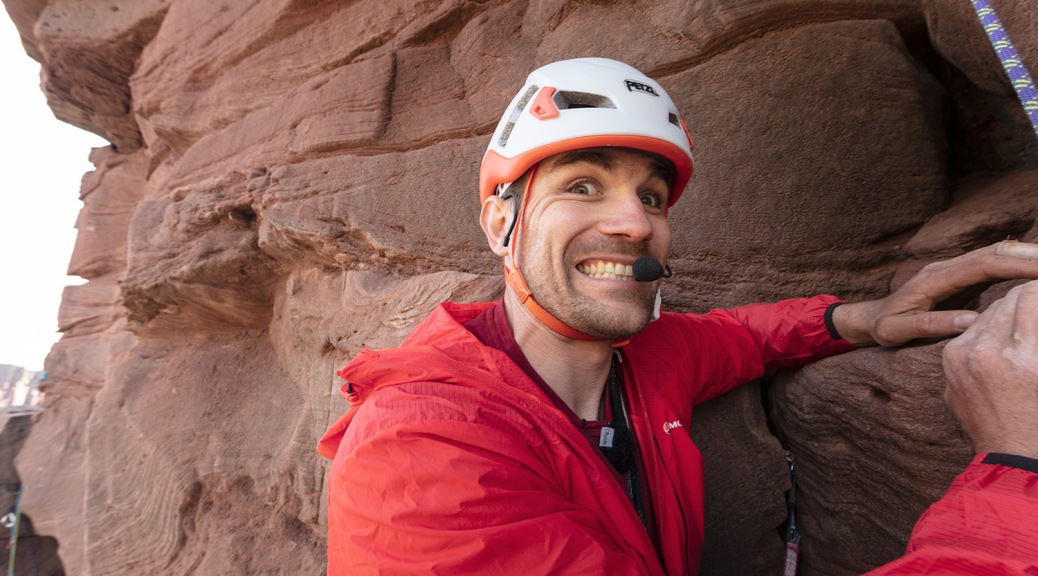
What can you see?
I only have light perception in an extremely narrow field of view. The best analogy I have is, imagine that you are looking down a small drinking straw and that straw has many layers of cling film over the end. Essentially I can tell whether the end of the straw is light or dark, but that is it. If I hold my hand 1 foot from my face I can’t see it. Critically when I’m climbing, I can’t see any of the handholds or footholds, the cracks to place the gear in or the gear as I’m placing it, all my climbing is done just by feel.
Why do you wear a blindfold?
I only wear a blindfold when I’m climbing indoors. This is because for me, indoor climbing is preparation for paraclimbing competitions. In the competitions I compete in the B1 category and all competitors in this category must wear a blindfold when they compete. Therefore, I always wear a blindfold when I’m climbing indoors so that it’s as similar to the competition environment as possible. It doesn’t make any difference, I can’t see the holds without it on. I don’t wear a blindfold when I’m climbing outside, because for me, climbing outside is not about competition, it’s just about me climbing the routes I want to climb.
Why climbing?
Climbing is something I’ve always done and something I enjoy. It presents a multifaceted challenge that I enjoy overcoming. It might not seem like the ideal sport for a blind person, but it’s much better than some! The rock shouldn’t move, whereas any kind of ball sport, (even if it’s the blind version) involves a ball which can be basically anywhere. I’ve tried blind tennis…it wasn’t a resounding success!
Do you practice your routes beforehand?
Not often, it depends on the style. For trad routes, 99% of the time, I climb the routes “on-sight”. So, that means that I’ve not practiced on top-rope beforehand, or got detailed information on how I climb the route from anyone else before I try. Most of the time Molly is guiding and she hasn’t climbed the routes before, so doesn’t have any extra information, other than what she can see from the ground. The only route I can think of, that I didn’t attempt to on-sight is Moyers Buttress, this is because the guidebook, made it sound a little unsafe. So for this route Molly led it first, with me following. I then decided it was fine, and then went back to lead it myself. At the time of writing, I’ve not got into trad head-pointing, maybe at some point I will.
For sport climbing, I’ve redpointed a few routes, but haven’t invested many sessions into them. I’ve had to make a conscious effort to redpoint routes, as coming from a trad background, I always tried to on-sight all sport routes.
Do you have a favourite type of rock?
Yes, I have favourite types of rock, anything where there is a big obvious feature like a crack, a corner, or an arete that a route follows is best for me. Basically something I can follow so I don’t get lost on the route. It also helps a lot when it is very obvious what is and is not a foot/hand hold. It’s easiest to think about what’s hard, imagine featured pockety limestone, where there are a myriad of small intricate foot placements. It is almost impossible to get the best foot placement and so is incredibly hard. Rock types like Gritstone and Quartzite are much better as it’s often clear when you do/don’t have the right hold.
Which forms of climbing do you do and which are your favourite?
Probably my favourite type of climbing is trad climbing, it’s the style of climbing where it all started for me and is probably the style that’s given me some of the best memories. I like the other styles of climbing too, but when I think back to my most memorable climbing experiences, most are on trad routes.
Does it help that when you look down, you can’t see the ground?
No. Nothing about climbing blind makes it easier! You still know where you are and still know what’ll happen if you fall off! It’s probably worse because the uncertainty is greater for me than someone that can see. In any case, it doesn’t help and I do still get scared like most other people.
Do you always climb with Molly?
Not always but probably 99% of the time. We met at Uni in 2004 and since then have done over 2,200 routes together outside so we know how each other work, and often Molly can second guess what I’m thinking and give the required instruction without me asking!
How does sight guiding work?
In competitions, in the B1 category, all competitors are blindfolded and you’re allowed a sight guide to direct you to the holds verbally. All sight guides use radios. It’s down to the sight guide and climber to devise a system for describing where the holds are, there’s no set rules for this. If you’re interested, check out VIClimbing.com for more info. Molly and I have created a system that works for us based on the clock face. It’s pretty complicated but it seems to work well.
For outside, it’s less structured and it’s not as easy for the sight guide to spot the holds or the sequence of moves. I’m much more reliant on finding holds by feel when climbing on rock. When I’m leading there’s the added complexity that I need to place gear, Molly can spot some cracks that might be suitable, but ultimately finding the right place and the right piece is down to me.
What’s your favourite cheese?
So I may have a bit of a reputation for being a cheese monster, after a trip to the Dolomites many many moons ago! I am partial to a bit of cheese, but I’m not sure I have a favourite one. My favourite few are Manchego, Bleu de Bresse, Raclette and Goat cheese.
 Jesse Dufton Climbing Blind