Sun streamed down onto the roof terrace, as I sat with Molly, basking in the warmth that was sporadically stripped away by a gust of the cold breeze. Adjusting the cushion on the overly upright metal chair, I tried to summon the motivation to get our kit sorted and head out climbing, make the most of the weather. I failed and continued to sit there, feeling the heat on my skin shift as the sun slid inexorably down towards the horizon. The 3am start to catch our flight had drained me. I could only imagine how Molly felt, having had to do the driving out into the mountains while I napped in the passenger seat. I felt guilty, she must be even more tired than I am.
We’d arrived at the gite in the early afternoon and had been welcomed in. Molly’s recollection of French from school had abandoned her and I was no better as I had opted to study Spanish instead. The only notion of the French language my tired brain could retrieve was a tale of a family friend who had gone to a boulangerie in Fontainebleau to get some bread and realised the only number he knew in French was ‘soixante-neuf’, he didn’t need that many baguettes, and the anecdote wasn’t that useful right now. I stood by as Molly reverted to sign language and smiles to do our introductions to our Moroccan hosts.
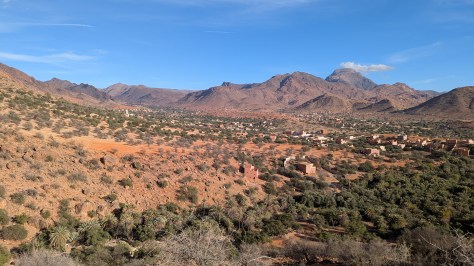
A classic Moroccan landscape in the Anti-Atlas.
The afternoon’s warm sun is what I generally expect from Morocco. Unfortunately, the weather forecast was not sanguine about the chance of good weather for the week of our trip. To our consternation most days had at least some rain forecast. Saturday looked dry until early afternoon, so we headed to “The Crevasse”, a small roadside crag, hoping to get a route in before the rain arrived.
The routes start from the top of a huge flake that forms a bergschrund beneath the main cliff. I started up Saga Lout, feeling distinctly rusty at trad climbing having not placed any gear since our trip to Red Rock in October 2024, some 4 months ago. After an initial rising traverse, the wall bulges, feeling slightly overhanging. I pulled up into the crux sequence, flailed around ineptly and ultimately fluffed it, taking the ride onto my gear. It took multiple attempts to head back up, locate the critical holds and piece together how to use them. Eventually I made it past the crux and crack that followed, up to where the angle eases for a final slab. I pulled over the change of angle only to feel the first spots of rain on my face. I scurried as fast as I could to the top of the route, my sixth sense coming into its own as I found the anchor and abseil station immediately. The rain intensified as Molly climbed and by the time she reached the final slab it was soaked and unclimbable, forcing her to yard on the rope. Abseiling quickly to the base of the route we sheltered in the crevasse, out in the valley the wind whipped the rain, we’d made a good crag choice as we were shielded from the worst of the weather. Even so, the rain had truly set in now, everything was soaked, and we scuttled back to the car, the rest of the day was a write off.
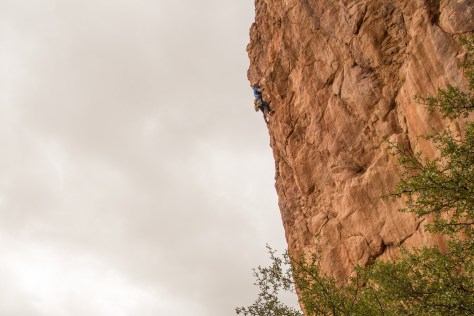
Jesse mid-route on the Money Shot E1 on Sentinel Rock.
In the morning the rain had ebbed, but the clouds clung to the mountains and threatened. We decided our best bet of staying dry was to head south out of the main massif to the Ameln Valley near Tafraout. During our last trip to Morocco in November 2023, it had been scorchingly hot, we had climbed at the north facing Black Crag with the temperature in the mid-thirties. Back then, we had skipped climbing at the nearby Sentinel Rock, as the crag faces south and we feared melting faster than a lolly under a blowtorch but now south-facing sounded ideal and even better Sentinel Rock is a small rock tower, it shouldn’t hold any water from the previous night’s rain and if the rain did catch us the routes are only short and so easy to run away from. Driving down out of the mountains in the north felt familiar behaviour for a British trad climber, the habit of running from the rain to Tremadog translated to the Anti-Atlas.
We parked up outside the village beneath the crag, Molly doing her best to decipher the rather enigmatic description of how to reach the crag. She guided me through the literal maze of small seemingly abandoned mud-built huts packed so close together the alleys between them were narrower than my wingspan. Jinking left then right we rose through the village and up the short escarpment behind, to arrive below Sentinel Rock. The highlight of the climbing was Money Shot, my trad skills still felt rusty, but at least my fingers felt strong.
Jesse on Trafalgar Crack E2+ on the granite outside Tafraout.
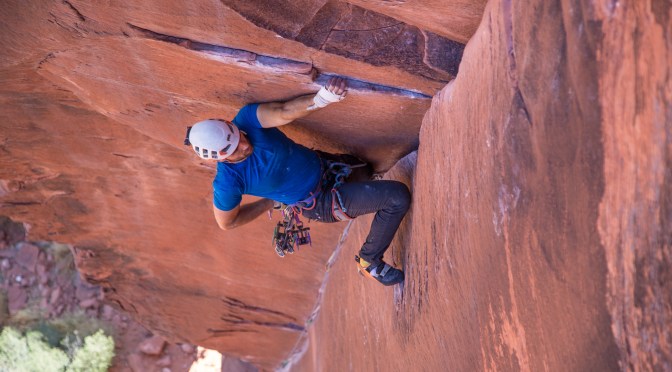
The pattern of running from the mountains to escape the weather continued through the trip, the comprehensive tick list of mountain routes we’d compiled beforehand remained unticked as we spent multiple days in the Ameln Valley or on the granite just outside Tafraout. However, there were several routes that stood out for me, the crack routes: Waterloo Crack, Trafalgar Crack and Onion Skin Crack. But the route that made the deepest impression on me was Pole Dancer. It climbs a freestanding pinnacle of deep orange rock that overlooks the valley, taking the foreground to a backdrop of imposing cliffs. The route climbs the tower in a mighty 40+m single pitch.
Jesse climbing Onionskin Crack E2 at Asgaour Gorge.
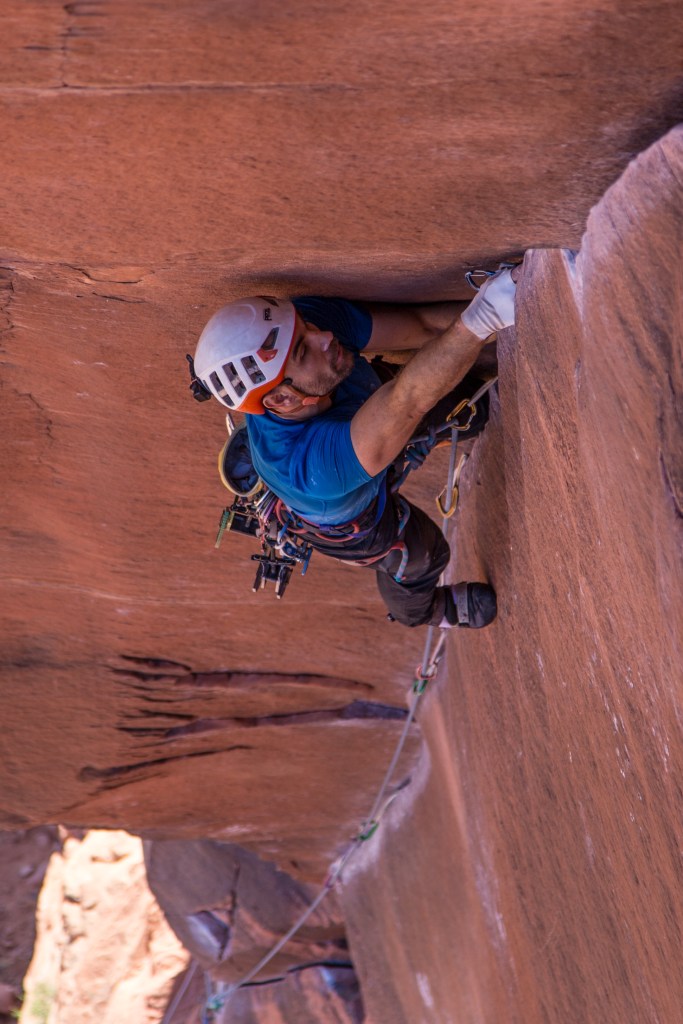
We had to crawl underneath a thicket of exceedingly spikey bushes to reach the base, and Molly took the opportunity to have a good inspection of the route with binoculars and decipher the snaking line the route takes. It starts from a platform on the right and then climbs left around the arete. It follows cracks on the left of the arete, past a clump of euphorbia, the nasty cactus with the stinging sap, until you are high on the tower. Then the difficulties begin. From the guidebook and her binocular inspection, Molly thought the route went back around the arete to the right face. I wasn’t sure. It seemed so improbable from where I was. The moves to get up and right onto the arete were hard, technical and balancy. I kept questioning if this was really the right way, reaching up to the left instead. “It must be up left”, “There’s no way it goes round there”, “these moves feel desperate” I thought. Only when I reached up left and dislodged a loose piece of rock did I admit to myself that the correct way must be to the right. With considerable trepidation, I moved up and right onto the sharp arete which forms a thin fin of rock beneath a steep and featureless overhanging wall above. I squatted precariously beneath the bulging wall on the fin, trying to work out how to go further right. I was stumped. Right of the fin, the wall is undercut, there is nothing to put your feet on. There is some gear, but it was a small dragonfly, not totally awe-inspiring and you would be moving horizontally away from it, increasing the potential pendulum with every move right. I faffed. Squatting uncomfortably on the fin, trying to work out what I had to do. I had already ruled out going left, straight up wasn’t an option, it must be right but it’s going to be hard, there are no footholds to speak of, well none that I can find anyway, and the handholds don’t seem great. Once I move right, I’m not going to be able to reverse the moves and if I mess it up, I’m going to swing horizontally into the arete, a nasty fall if the gear stays in, even worse if not.
Jesse at the point of no return making the improbable traverse to the right.
I must trust Molly, from this distance she can see the rough line of the route, but can’t point out any holds, it’s down to me, and with effort I swing right and past the point of no return. Dropping my feet lower to smear on whatever I can find; they’re not doing much for me. I crab out to the right, questing with my hands in search of something, anything, to pull on. Move by nerve jangling move, I leave the sanctuary of the gear behind. Molly silently belays, heart in mouth. Until, with great relief I find a sloping ramp with holds to pull me up onto it. I think it’s over, but where next? Farther right is covered in moss and lichen, but straight up above the ramp is overhanging, it’s got to be 20 degrees past vertical, surely it doesn’t go up there, does it? Molly does her best to direct me, but she’s finding it hard to see, not only because I’m a long way above her now, but also a sharp rain shower has blown in and it’s sheeting down, raindrops sting her eyes as she tries to look up and direct me. The saving grace is that the tower is shielding me, I’m not getting wet. Good job as the climbing is hard enough without wet holds to worry about. I recuperate on the ramp, the shower passes, and I suck in a huge breath and try and calm myself, before launching into the headwall. Molly can’t tell the angle of the wall from down below and is blithely telling me to “just head straight up there”. The wall is steep, and the handholds are side pulls, to use them I need feet out wide to push off, footholds that, obviously, I can’t see. With monumental mental and physical effort, I leave the ramp and set out into the second section of wild terrain. My arms, core and inner spirit level, all vie to be the first to complain to my brain about the angle canting past the vertical, all are given short shrift as I’m fully focused on trying to find those elusive footholds. As I work higher, I am relieved to find a crack that takes a good cam, at least I won’t be bouncing off that ramp if I blow it now. The relief blooms as the angle kicks back to vertical and then to slab, a few good jams and a jug later, with my lungs heaving and a huge smile splitting my face I pull up and onto the tower’s top.
The Pole Dancer E1 the most memorable route of the trip.
The feeling is intense, the sense of having passed some sort of test or survived a battle, but there is no opponent, instead it is more about self-discovery. Routes like this teach you a great deal about yourself, where your boundaries are and how close you can get to them. In this case, did I have it in me to face down those sections of wild improbability and uncertain outcome. Clearly, on this occasion I did and that brings deep satisfaction. As my mind slowly returns to the present, I realise that it’s intense for both of us. I can hear the moment she knew I’d done it; the quaver in her voice as tears flood Molly’s eyes in a rush of released emotion, the relief, the sheer delight, the belief she had in me, the unwavering trust, all realised. But it’s only when she climbs the route after me, removing the gear, finding the holds, following the vague line, that she fully appreciates the enormity of the challenge she’d set me. The memory of this route is unlikely to ever fade for either of us, and that makes us both stronger.
Team Dufton enjoying another cracking trip to Morocco.
In 2023 I was awarded a Bader Grant from the Douglas Bader Foundation. Sir Douglas Bader was a World War II fighter ace and double leg amputee who advocated maximising disabled participation, especially in the sporting domain. The DBF grant was intended to enable the demonstration of capability in the disabled community, specifically for me, by pushing the boundaries of climbing by a blind climber. A copy of my report for the DBF is reproduced below.
The trip didn’t have the best start, well actually it was worse than that, the original plan was scuttled by war. The intent had been to travel to Wadi Rum in Jordan, flights were booked excitement was high and then the horror of the Gaza conflict erupted, the airline promptly cancelled our flights. A year passed and sadly the war raged on. With flights to Aqaba still grounded and the airspace bisected by ballistic missiles, the backdrop for the trip shifted, no longer the red rocks of Arabia but the red rock of errr Red Rock Canyon (Nevada) and Zion Canyon (Utah) to be precise.
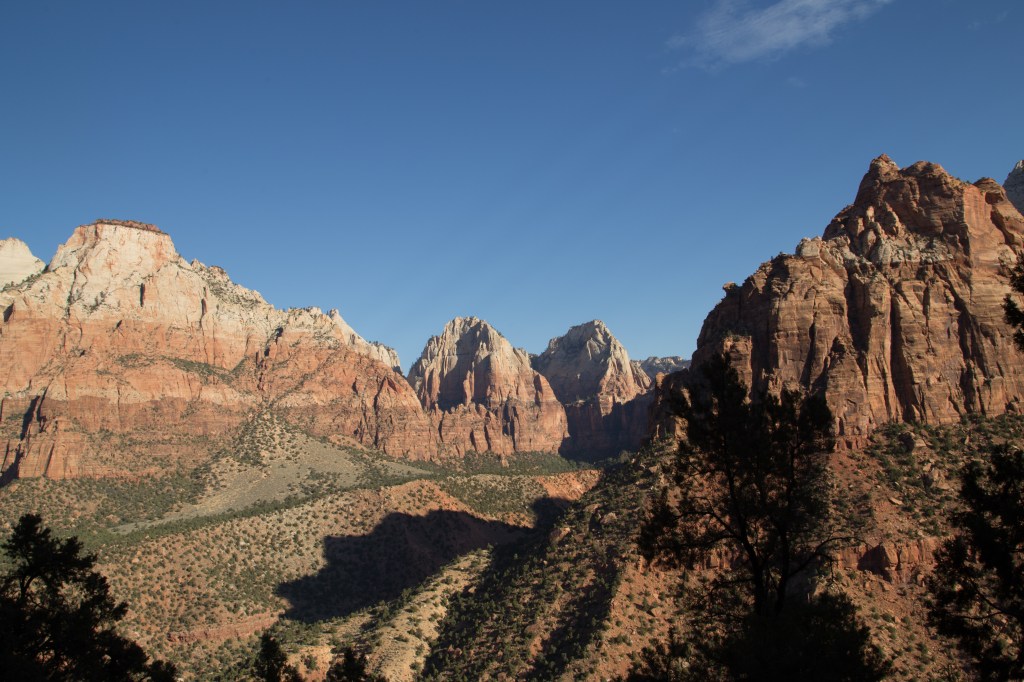
Zion National Park
The setting may have changed, but the objective had not; to successfully lead climb some of the iconic routes in the world-renowned desert playground. The twist? Well, I am completely blind, I lost my sight gradually through my twenties due to a genetic eye condition, rod-cone dystrophy. When I climb, I can’t see any of the handholds, or the footholds, or any of the safety gear. Clearly, this adds an additional challenge to that already posed by rock climbing.
One thing that is deeply important to me is the choice I made upon losing my sight, to continue leading. I should explain, traditional or “trad” rock climbing is done in a pair. To get from the bottom to the top, someone must climb first, we refer to them as the “leader” and to the following climber as the “second”. Leading is, in most cases, dramatically more difficult than seconding, both physically and psychologically.
Consequently, for many climbers, especially in the advanced and elite levels, the routes that you lead is the yardstick to be measured by. When I lost my sight, it was important to me that I didn’t allow my disability to impinge on this fundamental part of climbing culture. Yes, leading without being able to see the holds or the gear was going to be hugely more difficult and sometimes extremely scary, but, for me, climbing is in part about facing up to the challenge and seeing how you react, my genetic fate had simply enhanced this aspect of the climbing experience. I was determined to not let my disability change the way I climbed, more than was necessary. So, with the support of my main climbing partner, Molly, in the decade between 2009 and 2019, I had re-learned how to lead without my vision and I was now looking to push my climbing to a level I had never reached before, harder than I had ever climbed before I lost my sight.
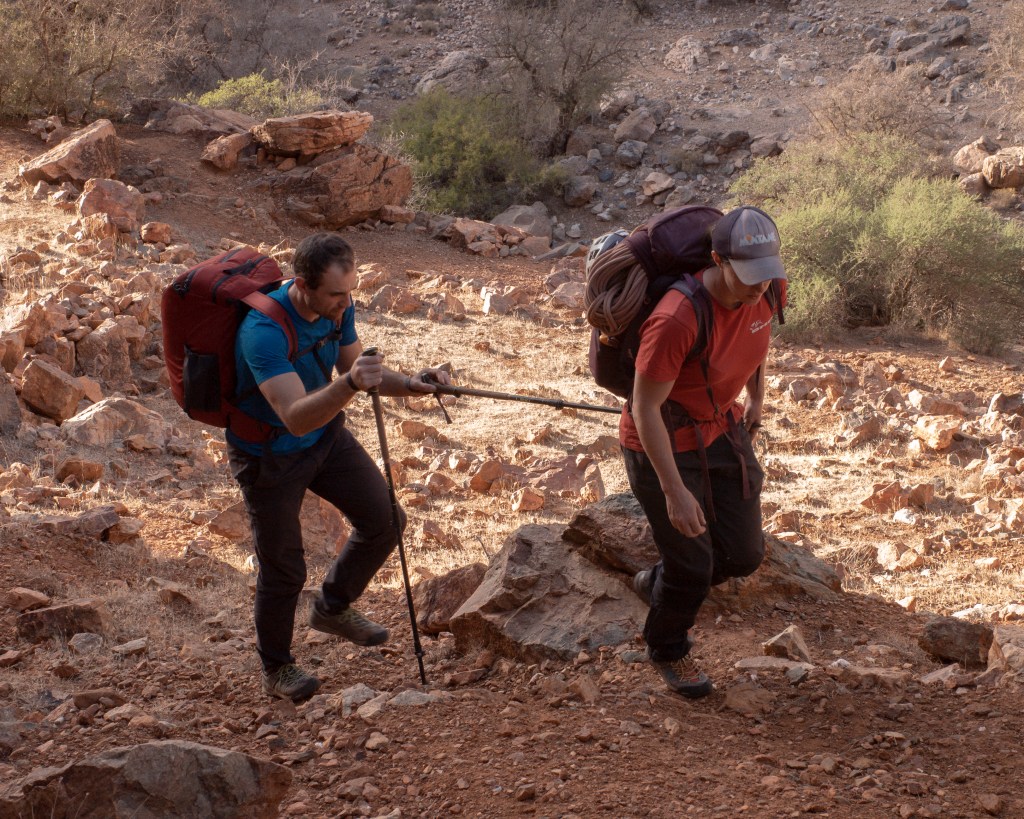
Molly leading Jesse with his walking stick when hiking to a crag.
Unfortunately, the omens weren’t looking good. I had torn the cartilage in my left shoulder months before the trip and the injury had prevented me from climbing or training properly. If the changed location and injury weren’t enough, the weather seemed to be against us as well. The average temperature for October is supposedly 19oC, but in the first few days of our trip the mercury topped out at 43oC! Climbing in the sun was out of the question and even in the shade our climbing performance was going to be severely adversely affected by the extreme heat. For context, my ideal temperature for the best performance is about 10oC with temperatures in the teens being pleasant.
Our plans and objectives had to adapt. We ruled out some of the extremely long climbs we’d had on our list, it simply wasn’t going to be practical to carry enough water with us to sustain the continuous 24-hour effort that would likely be required. Instead, we gravitated towards the shorter sport climbing, which is much less committing.
Much of the climbing is on the side walls of the various canyons that cut into the fractured desert landscape. Finding the shaded sectors where the climbing is shielded from the sun’s fiery glare was crucial. Though, even in total shade, rising before dawn to climb in the coolest part of the day was vital.
I did everything I could to stay cool, casting hygiene aside I soaked my T-shirt and cap in the melted ice water in our cooler before setting off for the day. I was bone dry by the time I reached the crag.
Keeping cool…!
By mid-afternoon the heat became oppressive forcing an early end to the day’s climbing and a return to the sweltering campsite.
The four of us, Jane, Andy, Molly and I spent most of the first week getting used to the sandstone and acclimatising to the heat. I was deliberately pacing myself, not wanting to aggravate my shoulder and doing my physio rehab exercises with the devotion of the most dedicated zealot. There’s a distinct lack of 12kg dumbbells in the desert, so each climbing day started by searching for an appropriately sized and shaped rock that I could use to do my rehab with instead.
Jesse completing his shoulder exercises in many different locations.
For me the highlight of the first week was a route called Glitter Gulch, which climbs a gently overhanging wall. When routes are overhanging, climbing them efficiently is crucial. Opportunities to rest your arms are rare. To have the best chance, it’s important to identify the correct sequence in which to use the holds and move quickly. Unfortunately, being blind makes both problematic. I can’t see the holds and plan how to use them like most climbers. Also, because I can’t see the target of a hold to lunge for, I climb slowly and methodically. The style gives security, but is much more tiring, especially on overhanging terrain. So, verbal guidance from Molly on where the holds are, as best as she can see from the ground, makes a dramatic difference to me. The radio headsets we wear mean that we can easily communicate, critically she need not shout. I climbed well on Glitter Gulch, managing to stay cool, well metaphorically at least. I was in the zone, climbing efficiently, body on autopilot, my subconscious mind running the show in the background, choreographing the complex and coordinated movement patterns honed by years of practice. Gliding between the holds, making the moves that would normally be a physical battle seem smooth and effortless. I love the sense of mastery that occasionally comes in climbing. You know that the moves are hard, but when you do everything right, they feel easy. In those moments everything else is forgotten, no room in my mind for thoughts of work or chores, even my blindness is forgotten, everything is irrelevant except the execution of the moves. These ephemeral moments of clarity and focus are one of the things I love most about climbing.
A short section of me climbing Glitter Gulch
We’d always planned to spend the middle portion of the trip in Zion National Park, but with the heat sweltering in Red Rock we opted for the relative cool of Zion earlier than planned. Heading first to Lamb’s Knoll. Hiding, as ever, in the shadows of the canyon. To my delight, Molly took on her hardest route to date.
Molly on ‘Times a’ Wasting’ attempting to make the clip, nervous about dropping it!
An underappreciated difficulty posed by my blindness is the challenge of working out which routes to attempt. For sighted climbers, a large part of this process comes by consulting specialist climbing guidebooks, which list and describe routes in a climbing area. While digitalisation is gradually emerging most guidebooks are still dead-tree media, which, clearly, I can’t read. But also, I can’t see the photos, which is often a huge part of getting motivated to climb a route. So, Molly often helps by suggesting routes she thinks would be good for me or that I’d like from the guidebook. She suggested “The Headache”, if I’m honest, I’m not sure why I agreed.
It’s not that it is unsuitable, it’s perfect for me. It’s just the grade. Given 5.10b in the American grading system my brain would normally convert to a British grade for me to assess the difficulty in the context of other routes I’ve climbed. In this case I think my subconscious did the conversion to E2, but the bit that didn’t happen in my mind was to put that into context, there was no voice in my head saying, “hang on a minute, that would make this one of the hardest multipitch trad routes you’ve ever tried”. For some reason my hindbrain processed the data but didn’t flag the result. In retrospect, this was a good thing, as I didn’t get stressed by the thought of pushing hard with my shoulder still under-strength and no recent hard climbing to boost my confidence.
The route is 115m tall, climbing ropes are generally 60m long. So, you can’t climb the route in one go, you need to break it down into sections called pitches, 3 pitches in this case. It’s essentially like stacking three single pitch climbs on top of one another. The first pitch starts with a “splitter” crack, plumb vertical totally parallel-sided there are no features to pull on. Instead, you climb by torquing your hands and feet into the crack. I quite like this style of climbing, my blindness is less of an issue, finding the way and the holds is easy, follow the crack. But it’s still extremely technical and physically demanding and I reached the end of the first pitch sweaty and scraped.
Jesse starting up the first pitch of ‘The Headache’
Normally, climbs are split into pitches in such a way that the belays, transitions between one pitch and the next, are on ledges big enough to stand or sit on. However, nature didn’t design the cliffs for climber’s comfort and occasionally there is no adequate ledge in the right place. This is the case on The Headache. Consequently, you must have a “hanging belay”, where you connect yourself securely to the rock and then hang uncomfortably in your harness while your partner climbs up to meet you. I particularly dislike hanging belays. As your partner climbs up you take in and coil the rope, but there’s nothing to coil it on apart from your legs. Ideally, you should coil the rope neatly to avoid knotting or dropping a loop into the void beneath you, when you can’t see, keeping everything nice and tidy is particularly difficult.
The second pitch is slightly easier than the first, it is the third and final pitch that is the crux. There is a long section of crack climbing that felt insecure to me. The geometry of the crack made it difficult to torque my hands and feet in securely and I was worried about falling. Especially because, the pitch is long, so the gap to my last piece of gear quite large. Had I fallen, it would have been a big one. The closest I came was right near the end. There is a peapod shaped slot, narrower than shoulder width, but just wide enough to squeeze into if you turn sideways. The inside of the peapod is totally shear, nothing to grab to pull yourself inside. I was pressing outwards with both palms almost trying to breaststroke up into the slightly overhanging slot. Half-way in, my left palm slipped, sliding a foot or so down the shear inside wall of the peapod. I panicked, thinking about the drop below and my last gear, how I really did not want to test whether it would hold. Adrenaline flooded my veins, and I engaged the “turbo-squirm” writhing inelegantly and thrusting myself into the slot with everything I had. I wriggled in, my breath rasping, mouth dry and heart hammering in my chest. Taking a few minutes to recover before climbing, tentatively, the final 5m to the top of the route. I reached the end of the hard climbing. The Headache has bolted anchors at the end of each pitch that you can use to secure yourself and to abseil off to get back to the ground. I knew that there would be a bolted anchor up here somewhere, could I find it? Of course, not… My lack of sight messing with me again, I’d done all the climbing, I was basically done, but I couldn’t find the final thing to attach to. Frustration roiling inside me as I know I must be within 2m of the anchor, but despite methodically stroking the rock walls in search of it I still hadn’t found it. If I could see this would be totally trivial. I gave up, built an anchor using my remaining gear and brought Molly up to join me. Let’s use her eyes to find the damn anchor. It was about 1m left and slightly down from me.
As I abseiled back down, the enormity of what I’d achieved still hadn’t processed in my mind, it was all still a blur.
Overjoyed with my success on The Headache and that my shoulder had not rebelled and regressed with the effort Molly, and I decided to attempt something ambitious, a route called Namaste. It’s a sport route, which means that metal bolts have been drilled into the rock at intervals, when you climb you can connect your rope to these bolts as you reach them. You can be confident that the bolts will not come out if you fall onto them, which is not guaranteed with trad gear. Consequently, having the bolts reduces the risk of injury in the event of a fall and so you can climb at your physical limit, no need to fear falling or to have a physical margin as is prudent on some trad routes.
Namaste is graded 5.12a (F7a+)in our guidebook, making it the hardest route I had ever attempted. I had only climbed two sport routes of comparable difficulty before, and both had been a notch below the grade of Namaste.
The route is set on a north facing wall deep within Kolob Canyon. The path weaves through the trees and shrubs that fill the canyon’s base, hemmed in by the huge sandstone walls that soar above on either side. I fell into the well-practiced routine on the gently rising path. Molly walks ahead and I follow using a pair of sturdy walking poles to give me stability and allow me to tolerate the fact that I put my feet in all the wrong places. Generally, Molly says nothing, I simply listen to the sound of her footsteps and try to follow directly behind. She does warn me of trip hazards and low branches, well most of the time, as she is significantly shorter than me, she occasionally forgets that branches she can easily walk under hit me in the face. We continued up the canyon for about 45mins, I listened to the unfamiliar birdsong and smells of the flora, mostly that distinctive “health food shop smell”.
Jesse following behind Molly on the way to Kolob Canyon
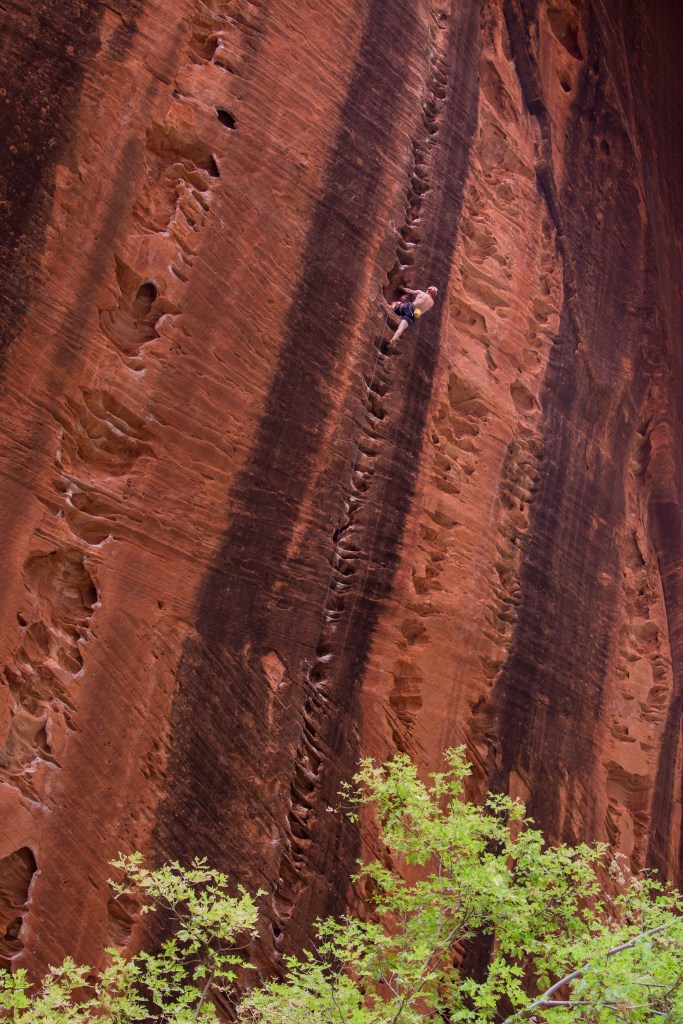
Rounding a bend in the canyon the routes reveal themselves. They are steep, by which I mean severely overhanging. Namaste is ridiculous. It is steepest at the start, at least 25 degrees overhanging, in the later half the angle eases a little but it is still at least 15 degrees past vertical. To add to this, the route is long, approximately 42m on the diagonal. Molly describes the route as highly improbable, it follows a series of large holes known as Huecos that are the only features on the otherwise totally blank wall. The route took several attempts, initially I had struggled to work out where to put my feet for the hardest section. We came back having rested, because each attempt is so physically draining, when I blew my first two attempts, I thought I’d drained my tank too far.
The surreal features and walls of Kolob Canyon
Fortunately, with my friend’s encouragement I gave it one last go at the end of the day. I put my feet in the right place this time and then at the second crux move I rolled my body around perfectly, letting me grab the next Hueco in smooth control. I’d made it past halfway and the fire in my forearms started in earnest, the chemical burn of lactic acid flaming in my muscles and veins, the taught feeling as my engorged arms swelled with blood. But there is nowhere to rest yet. I play the delicate balancing act of distributing the pump. Hang from my left hand while desperately shaking my right arm to let my right rejuvenate, before swapping hands and another batch of frantic restorative arm flailing. I claw back enough recovery to make the next move, and the effort redlines my arms again, the cycle of wild arm flailing starts again as my chest heaves like bellows, sucking in as much air as I can to sustain the effort and fight the fire that rages in my arms. But I’m not fully recovering, just staving off exhaustion.
Jesse leading Namaste in Kolob Canyon
I need to rest my arms. I fight on, hauling myself towards a large Hueco and the sanctuary it offers. With relief, I reach it and have the puzzle of contorting myself into a ball to fit inside. I flounder about, trying to work out how to rest. Eventually opting to tuck my right knee deep into the hole and cam it upwards, using my core to enable me to let go with both hands. Blessed relief in my arms, like the sprinkler system has kicked on and the flames are doused. I’m recovering, but not fully, having to use my knee and core to stay here means I’m never going to fully recharge no matter how long I stay. So, with trepidation, I leave my contortionist’s sanctuary. The burning in my arms rekindling rapidly. It’s a long way between bolts on this route and as I pull up rope to clip it to the next bolt my right hand threatens to give out. My left-hand fumbles with the rope and my nerves jangle, the prospect of plummeting into the void beneath my feet isn’t at all appealing. With this much rope out and the gap to the last bolt the fall would be enormous, my friend Andy is belaying, holding my rope at the base of the cliff. If I fall now, he’s probably going to be yanked off the ground, like a rocket leaping for the stratosphere. “So, calm down and get the rope clipped” my rational part urges. It takes three more attempts to get the rope in, the strange war in my head between the calm and rational voice of composure and experience set to the deafening drumbeat of my pounding heart. I manage to keep it together, my arms are an inferno as I reach the second rest, a huge Hueco that I insert myself into, wedging my shoulders behind the lip on either side.
Only 5 more moves, but I dare not go yet, I’m so close, a mistake now would be heartbreaking. Instead, I wait nervously as my body slowly quenches the blaze in my arms and my pulse slackens. Gradually, almost imperceptibly at first, the fire sputters and dies. Its embers denoted by a deep dead ache between my wrists and elbows, it’s as much recovery as I’m going to get. My arms will need a full day to return to normal, so I summon the last vestiges of power and make the final moves. Disbelief, exhaustion, euphoria mellowing to contentment, I don’t know how to describe what I feel as I clip the rope into the anchor marking the end of the route. I am lowered back down and retrieve my gear from the bolts. This is made extremely difficult by the steepness of the overhang, and the swing I take as I unclip the final one is monstrous, not that I care, I’m still overjoyed at completing my hardest ever sport route.
Taking the big swing after retrieving my gear!
The day after, we call into the local climbing shop, the lady manning the desk is clearly bored and wants to chat. We exchange the normal pleasantries “Are you from the UK?”, “What’s your local climbing like?” etc. The conversation turns to what we’ve been climbing in the States, and we give a summary of the trip so far, culminating in climbing Namaste yesterday. Then my mates drop me in it. “You should probably tell her you’re blind Jesse”, my cover has been blown. I do regret the fact that I can’t see the lady’s facial expression, I know Molly particularly enjoys the mix of surprise, bafflement, disbelief and amazement that pan across the lady’s face as she thinks about the route I climbed and then thinks what it would be like to climb it without your eyes. But, as the fact that I’d not mentioned it until prompted shows, I’m still a bit embarrassed by these conversations and it still surprises me that often people don’t realise that I’m blind. Far better for my mates to raise the subject than to bring it up myself.
The temperature has dropped from searing to merely very hot, and so we returned to Red Rock for the last few days before flying home, waving goodbye to Terry the Tarantula, whose burrow we had unwittingly pitched our tent beside. I can’t comment, but I have it on good authority that Terry was massive and very scary. Fortunately, I don’t suffer from arachnophobia.
I was buoyed by success on The Headache and Namaste. My mind turning to an objective that had seemed outlandishly optimistic at the start of the trip, to “on-sight” a trad climb graded 5.10d. The “on-sight” describes the ethics with which you approach the climb. It is regarded as the most challenging and thus most prized paradigm in which to climb. It means that you start with no prior knowledge of the route, so you’ve not practiced on a top rope first, or watched another climber for clues on how to make the moves, you turn up at the crag and climb the route first go, with no falls. The irony of the term “on-sight” juxtaposed with my blindness is not lost on me, and thus I usually describe my style as “non-sight”.
Jesse having a great time in the desert!
When pushing your limit, it’s prudent to pick a route that plays to your strengths. Fortunately for me, one of the “Must Do” routes in Red Rock is a route called The Fox, it suits me perfectly, a huge corner crack that gradually widens as you climb higher.
I knew that to give myself the best chance I wanted to climb the route as early in the day as possible to get the coolest temperatures, but also, when I attempt a climb at my limit I generally want to get on with it, because it is the only thing I will be thinking about and the waiting and anticipation drives me insane. So, the night before I could barely sleep, and not just because the night was so hot. I woke, thinking that dawn was near, “Is it time to get up Molly?” “No! it’s 2am, GO TO SLEEP!”. Dawn eventually arrived and I hurried the team up and out, rushing my friends’ caffeination ritual.
The Fox sits high on the mountainside in Calico Basin; to reach the base we scrambled up a long series of stacked rock slabs. Fortunately, this proved easier than expected.
I did my best to calm my nerves as I put my harness on and attached my gear, making sure to arrange it in size order so that I can find the piece I need quickly despite not being able to see the colours which most climbers rely on as an aid. Andy belayed again so that Molly could stand out from the wall and have an unobstructed view to help her guide me effectively.
I set up and started the climb. The first 10m has a difficult section to reach a ledge at the base of the main crack. I worked my feet up slotting in 2 pieces of gear, each narrower than my little finger. As I went to move up the hold my left foot was standing on snapped off from the wall. I instinctively clung on and readjusted; my adrenalin spiked. Not the relaxed intro to the hardest route I’d ever attempted that I was hoping for. Refocusing, I made a sequence of intricate and difficult moves to reach the base of the main crack.
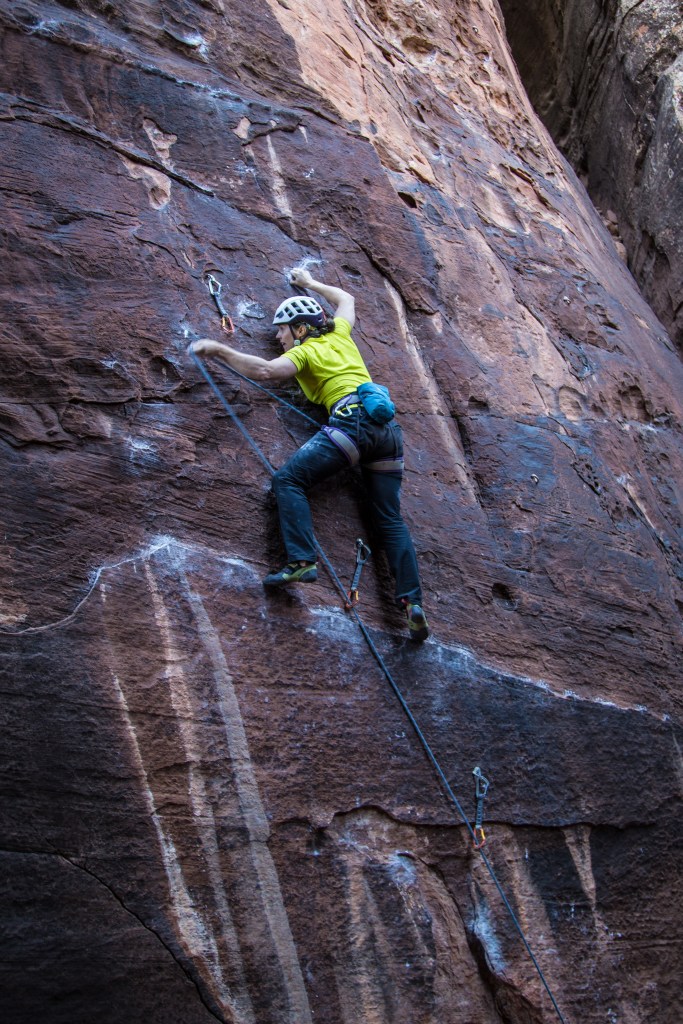
Jesse placing gear as he climbs The Fox.
From here the walls are completely smooth, there are no features to push or pull down on, only the vertical crack. At this point it is too narrow to torque your hands into. I opted to “layback”, where you pull on the near side of the crack with your hands and simultaneously push on the far side wall with your feet creating opposition between them. The horizontal force you create by pulling with your hands is what stops your feet from slipping down the featureless vertical wall. It’s extremely strenuous, if you stop pulling for an instant your feet will slip. So, I knew that as soon as I started the layback, there was no going back, so to speak. Anticipating what was to come I reached as high as I could and put gear into the crack above my head. Stopping mid-layback to place gear is exceptionally difficult and risky. The time had come, and I planted my feet against the smooth face of the left wall, pulling hard with my arms and the muscles in my back I committed and left the ledge. “Do not stop” my subconscious was screaming at me as I brawled upwards, rolling my shoulders back and forth as I shuffled my hands up the crack and padded up the blank wall with my feet. My feet threatened to slip, and I deliberately forced my right hip against the corner, making sure to align all the vectors of force my taut body was outputting, If I lost the opposition between my hands and feet for an instant gravity would swiftly reclaim me. I chugged upwards like a steam train following the tracks of the crack until I reached a small sloping rail running horizontally across the left wall. Stepping up onto it and levering myself higher, finally being able to catch my breath.
Jesse laybacking the initial crack section on ‘The Fox’
The crack widens and I switch to torquing hands and feet. I climb higher and higher changing from torquing hands to fists to the point where I can get my leg stuffed inside. I feel secure, but the climbing isn’t exactly elegant. Writhing to shuffle my jammed leg upwards, like a beached sealion up the final section. Molly clearly knows I’ve got it in the bag as she’s not calling out holds anymore, instead teasing me by narrating my progress like Attenborough in a wildlife documentary, as if I am a particularly blundering walrus attempting to mate. You know who your friends are…
I ignore her teasing and make the final move. My grin threatening to dislocate my jaw.
What a turn around. To begin with everything seemed to be stacked against me, the changed location, the injury, the excessive temperatures. At the start of the trip, I wasn’t sure if I’d be able to climb at all, and here I am now with my hardest multi-pitch, my hardest sport climb and my hardest trad climb all in a single trip. I’m proud of the resilience and positivity I drew on to get these done. But more importantly, I’m grateful to my friends, to Jane, Andy and especially Molly without their encouragement, support and companionship I wouldn’t have been able to do any of this. Climbing is such a strange mix of the individual and the collective. Yes, pulling on the holds is just down to you, but you wouldn’t be there without your friends’ support, without Jane’s knowledge and encouragement, Andy’s positivity and endless energy and of course Molly’s calm guidance. The beautiful thing about climbing friendships is that it’s now my turn to return the favour, and I can’t wait.
Jesse on top of ‘The Fox’, his first successful 5.10d non-sight!







 Jesse Dufton Climbing Blind